
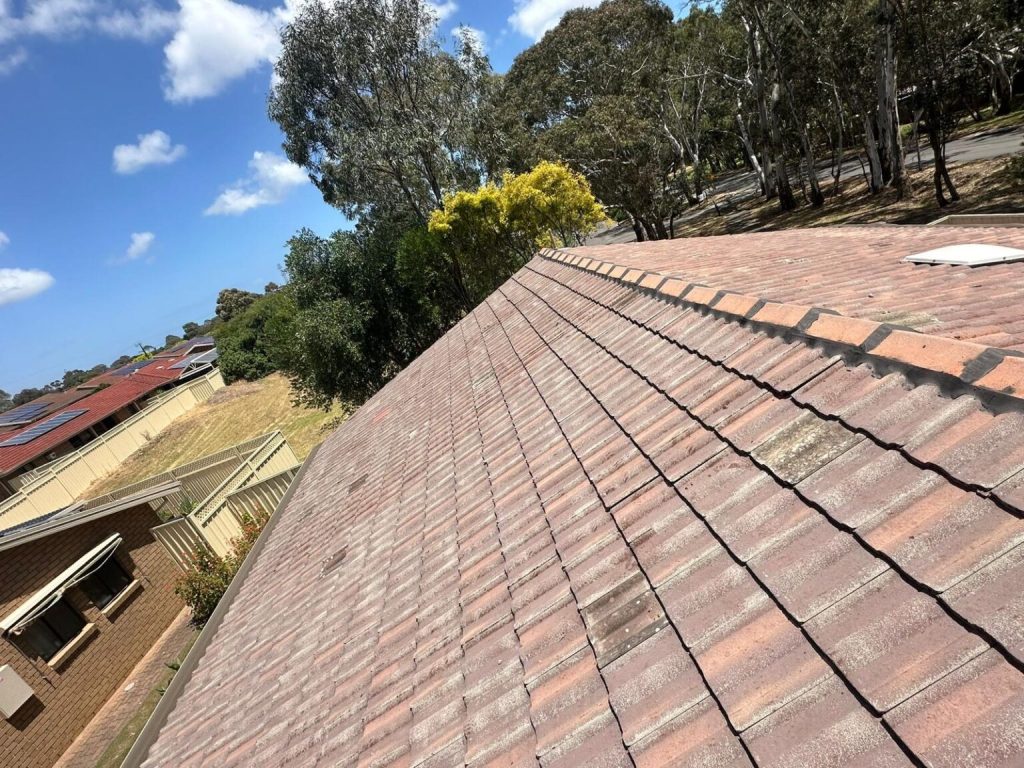
Most Adelaide homeowners never think about their ridge caps – until there’s a water stain on the ceiling or tiles start shifting after a big storm. The thing is, ridge caps give you plenty of warning before they fail. You just need to know what to look for.
Here are five signs it’s time to call a professional.
Take a look along the very top of your roof – the peaked ridge line where tiles meet. If you can see the mortar has split or crumbled, that’s a clear sign the bedding is breaking down. Old mortar dries out over time, and Adelaide’s heat cycles speed that process up considerably.
This one’s easy to spot without even getting on the roof. If you’re cleaning your gutters and finding small chunks of grey mortar mixed in with the leaves, they’re coming from the ridge line. It means the pointing is actively breaking apart and washing down with every rainfall. Don’t ignore this – it only gets worse.
Properly secured ridge caps shouldn’t move. If any of them shift when there’s wind, or if you can see gaps where tiles have lifted slightly from the roof line, the bedding underneath has failed. Loose caps in an Adelaide storm can become a serious problem fast – both for water getting in and for tiles coming down altogether.
Some leaks only show up as a damp patch or discolouration on your ceiling after a storm. Because ridge caps sit at the highest point of the roof, even a small gap lets wind-driven water push straight in. If your leak seems to appear and disappear with the weather, it’s most probably the ridges.
Even if you can’t see obvious damage from the ground, old mortar has a lifespan. Most traditional cement-based pointing starts to fail somewhere between 10 and 15 years. If you’ve never had the ridge caps looked at, there’s a good chance they’re overdue.
If you’ve never had it done before, it’s worth knowing what a proper job looks like – because there’s a big difference between a quick patch and a restoration that actually lasts.
Most homes are done in a day or two. And once the pointing sets, your roof is watertight again.
Ridge cap damage doesn’t fix itself – it spreads. A small crack in the mortar becomes a gap, water gets under the tiles, insulation gets saturated, and before long, you’re dealing with a leak that damages your property. A straightforward ridge cap restoration turns into a much more expensive repair job.
At Master Roofing Adelaide, we restore ridge caps properly – lifting loose tiles, removing old mortar, reshaping the bedding, and applying flexible pointing that moves with your roof instead of cracking again. No bandaid fixes, no shortcuts.
If any of the signs above sound familiar, give us a call on 0468 901 509 for a free, no-obligation roof inspection. We’ll tell you honestly what’s going on and what it’ll take to fix it.
Book your free inspection now!